Ag₂MgSiO₄ is a silver magnesium silicate that, in the sources we searched, has not been reported. Our research harness nominated it as a target for low-temperature ion exchange: take the known sodium compound Na₂MgSiO₄, hold it in molten silver nitrate, and swap Na⁺ for Ag⁺, with the silicate framework assumed to stay in place. We computed whether that swap is energetically favorable and how the product compares with known silver silicates. It is a computed candidate. We found no report of anyone making it, and we have not made it.
Then we did something we consider as important as the nomination: an AI-led re-audit of the archived calculations behind our preprint (not human peer review, and no new calculations). Re-reading the stored outputs reproduced the exchange energy and the restricted hull energy. Three property claims did not survive. We withdrew the visible-light absorption assignment and the claim of a computed ion-migration barrier, and we narrowed the phonon-stability claim. This post says what held, what did not, and why.
Why an exchange route, not a database hit
Many inorganic compounds exist only because a particular route delivers them. Low-temperature ion exchange replaces the mobile cation of a stable parent with another cation and, if the anion framework survives, can yield phases that sit above the thermodynamic hull and cannot be crystallized directly. Screening computed databases is a poor guide to such phases: structures built by element substitution of known prototypes are often already listed there, so absence from a database is not evidence of anything. Any novelty claim has to rest on the literature and on a route that looks feasible.
The route here starts from Na₂MgSiO₄, a known compound with a structure reported by Baur et al. (1981) and two experimentally described polymorphs, Pc and Pna2₁. Closely related silver compounds have been made from sodium parents in molten AgNO₃. Vaivars et al. (1995) reported Ag₂ZnSiO₄, Ag₂ZnGeO₄ and Ag₂BeSiO₄; Nalbandyan et al. (2017) reported Ag₂MnSiO₄, with incomplete exchange. In the text of neither paper, as read by our AI agents, do we find Ag₂MgSiO₄ or any other silver magnesium silicate. Nalbandyan et al. do name Mg in the formal scope of the structure family and list Na₂MgSiO₄ in a structural comparison, but they describe no silver magnesium silicate. Ag₂MgSiO₄ differs from the nearest precedent only in the divalent cation.
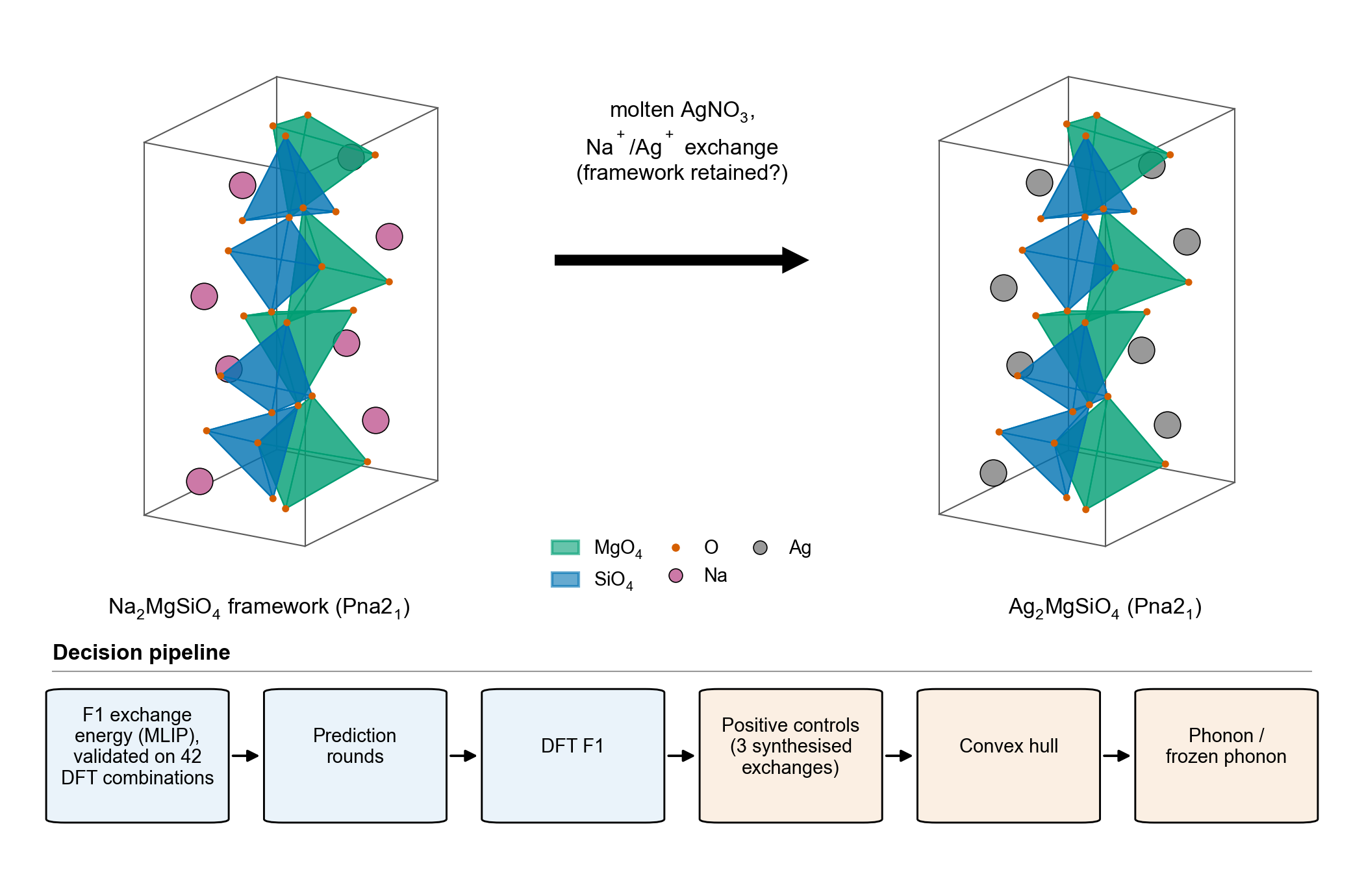
Concept and decision pipeline. Left: the assumed pathway, in which the tetrahedral framework of Na₂MgSiO₄ (Pna2₁) is retained while Na⁺ is replaced by Ag⁺ in molten AgNO₃. Right: Ag₂MgSiO₄ (Pna2₁, PBE-relaxed; MgO₄ and SiO₄ tetrahedra shaded). Bottom: the sequence of checks applied. In the pipeline boxes, "validated on 42 DFT combinations" means compared with 42 published DFT values, a descriptive agreement among correlated values (see below), and "synthesised exchanges" means exchanges reported in the literature. Figure from the preprint; labels are in English.
| Compound | Status | Source | Exchange energy, PBE (MLIP), kJ/mol per Ag |
|---|---|---|---|
| Ag₂ZnSiO₄ | reported | Vaivars 1995 | −48.9 (−44.2) |
| Ag₂ZnGeO₄ | reported | Vaivars 1995 | −53.4 (−48.2) |
| Ag₂BeSiO₄ | reported | Vaivars 1995 | −46.6 (−43.3) |
| Ag₂MnSiO₄ | reported | Nalbandyan 2017 | not computed with DFT (−50.8) |
| Ag₂MgSiO₄ | predicted, this work | none found | −58.0, −57.6 (−52.8, −52.7) |
Nearest precedents. "Reported" follows the cited papers, whose PDFs were read by AI agents after our calculations; no human reader has independently verified those readings. The precedents establish that the silver products form, not that the framework is retained during exchange. MLIP is the machine-learned potential MACE-MPA-0 used for screening; the Ag₂MnSiO₄ value comes from the project record, and its raw output was not found in the archive. Our own literature and database search found no report of Ag₂MgSiO₄; ICSD, SciFinder, Reaxys and 1990s theses were not searched, so any novelty claim is limited to the Mg composition within the sources searched.
How the harness chose it, and what that choice does not show
The screening quantity is an exchange energy, which we call F1: the reaction energy per exchanged ion for Na₂MgSiO₄ + 2 AgNO₃ → Ag₂MgSiO₄ + 2 NaNO₃, computed from total energies of all four solids with the same method. It is a necessary condition only. A negative value says the exchange is not thermodynamically blocked at 0 K in the solid state; it does not say the exchange will proceed. We used it only as a rejection test: above +10 kJ/mol rejects, at or below −10 kJ/mol is required to pass, and values in between are "boundary".
We checked the machine-learned version of F1 against 42 published DFT exchange enthalpies from Suzuki et al. (2024). It reproduced the sign for 36 of 36 combinations whose magnitude is at least 10 kJ/mol; over all 42, the rank correlation is 0.995 and the mean absolute deviation 3.75 kJ/mol. The reference values are PBEsol enthalpies recomputed from the published total enthalpies (one table entry was replaced by the recomputed value rather than the printed sign), and for AgNO₃ and AgBr the published salt polymorphs differ from the ones our MLIP used. Matching them leaves the sign count unchanged and moves the deviation to 4.32 kJ/mol. That is real agreement, and it is also less than it looks. The 42 combinations are 21 reciprocal pairs within one structure family (the β-MGaO₂ gallates), and thermodynamic cycles tie them together: the coefficient matrix has rank 11. They are not independent experiments, so we report the agreement as descriptive and attach no confidence interval. An earlier, more elaborate version of the criterion failed its own checks and was never used for any candidate.
Two facts matter more for reading the nomination. Every sodium-parent exchange with AgNO₃ that we screened passed F1, so F1 did not discriminate within that set. Among the second-round reactions in it, the Mg compound was the only one without a report in the literature we examined, and we carried it forward on that basis. The selection was a judgement, not a result of the criterion. And our criteria were kept in a dated internal log that is a laboratory notebook, not an externally registered protocol. Many rules preceded the calculation they govern; some controls and follow-up procedures were added after related results were visible. Where this post says "in advance" or "pre-specified", it means written in that log before the calculation it governs. An earlier version of the manuscript described its criteria as "specified in advance". The preprint linked below describes them as documented decision criteria.
What held up: the energetics
At the DFT level (PBE), the exchange energies of both Ag₂MgSiO₄ polymorphs are strongly negative. The three reported exchanges, computed with identical settings, span −46.6 to −53.4 kJ/mol per Ag, so the window set in advance (the controls' range widened by 10 kJ/mol) is [−63.4, −36.6]. Both candidate values lie inside it.
| Reaction | PBE, QE 6.7 | PBE, QE 7.4.1 | PBEsol | MLIP (MPA-0) |
|---|---|---|---|---|
| Na₂MgSiO₄ (Pc) → Ag₂MgSiO₄ | −58.0 | −58.2 | not computed | −52.8 |
| Na₂MgSiO₄ (Pna2₁) → Ag₂MgSiO₄ | −57.6 | −57.7 | −65.1 | −52.7 |
| Na₂ZnGeO₄ → Ag₂ZnGeO₄ (reported) | −53.4 | −51.7 | −61.21 | −48.2 |
| Na₂ZnSiO₄ → Ag₂ZnSiO₄ (reported) | −48.9 | −49.1 | −57.15 | −44.2 |
| Na₂BeSiO₄ → Ag₂BeSiO₄ (reported) | −46.6 | −46.3 | −55.72 | −43.3 |
Exchange energies per Ag, kJ/mol. The Ag₂ZnSiO₄ control in the QE 6.7 column used a parent relaxed for only six optimizer steps; the sensitivity of that choice was estimated and does not affect the decision. The PBEsol column used PBE pseudopotentials with the functional switched, an approximation.
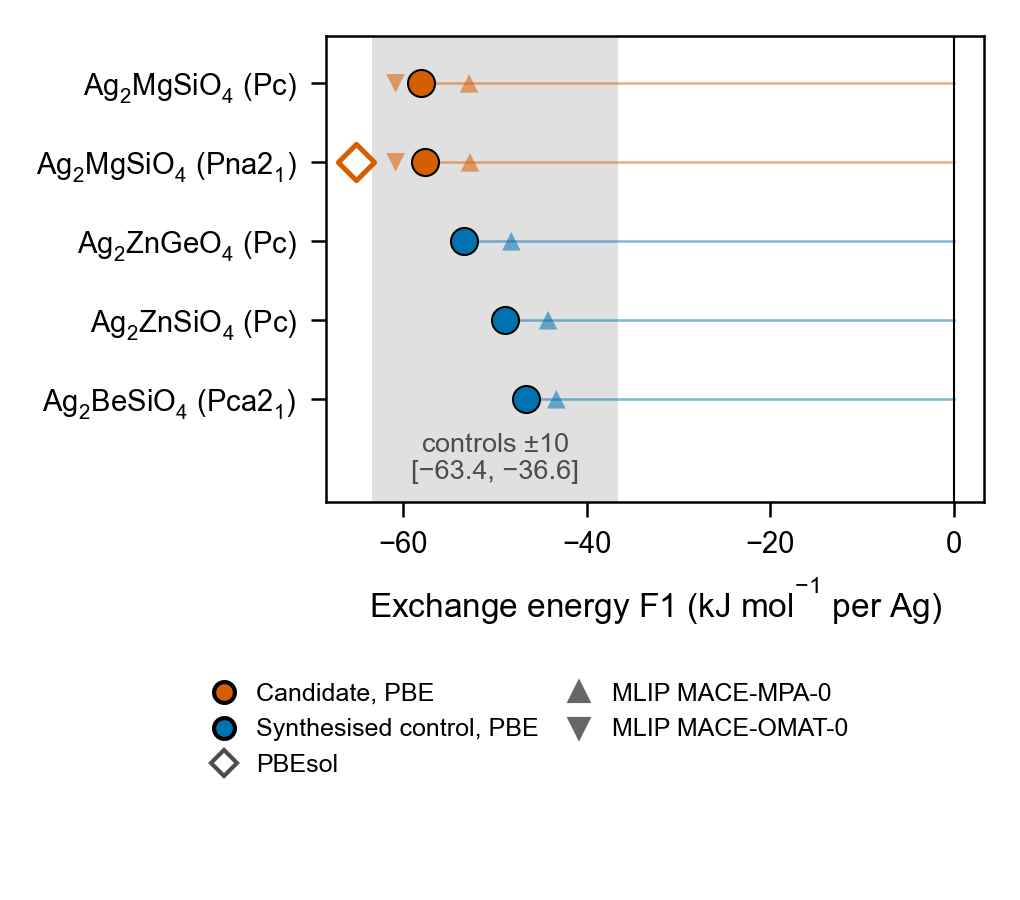
Candidate against the pre-specified window. Shaded: the window around the three controls. Triangles: the two MLIPs. Open diamond: PBEsol. The PBEsol value for Pna2₁ (−65.1) lies below the lower edge of the PBE window; in PBEsol all values shift by 7.8 to 9.1 kJ/mol for the controls and 7.4 for the candidate, and the window recomputed from the three controls in PBEsol, [−71.21, −45.72], contains it. Figure from the preprint; labels are in English.
Read this carefully. The candidate is 4 to 11 kJ/mol more exothermic than the controls, and that margin is comparable to the 8.0 kJ/mol spread between the two MLIPs (MACE-MPA-0: −52.8 and −52.7; MACE-OMAT-0: −60.8 and −60.8 for the two polymorphs). F1 as used here does not rank exchanges that all sit far below the pass limit; it only says this one resembles the reported ones. In the opposite direction, two computed negative or boundary cases, Li₂BeSiO₄ and Li₃AlSiO₅ exchanged with AgNO₃, give +8.45 and +1.96 kJ/mol, so they do not pass. Those are computational negatives, not experimental failures.
All of these values use the R3c form of AgNO₃ as the salt reference. Published PBEsol data contain a lower-energy Pbca form, and we did not find a same-settings PBE calculation of it. Swapping the salt would shift every per-Ag value by the same amount, leaving the comparison with the controls unchanged, but the absolute values and the classification of boundary cases could change. The two product polymorphs differ by 3.19 meV/atom in DFT, within the method's error, so we leave the polymorph undecided.
Energy above the hull. In the oxygen-balanced Ag₂O–MgO–SiO₂ composition triangle, Ag₂MgSiO₄ lies 0.038 (Pc) and 0.042 (Pna2₁) eV/atom above the hull, decomposing to Mg₂SiO₄ + SiO₂ + Ag₂O. Known silver silicates also sit above the hull in the same calculation: Ag₄SiO₄ at 0.016, Ag₂SiO₃ at 0.038 and Ag₆Si₂O₇ at 0.049 eV/atom. Two of the three controls computed the same way give 0.039 (Ag₂ZnSiO₄) and 0.057 (Ag₂BeSiO₄) eV/atom; for Ag₂ZnGeO₄ only a lower bound of 0.020 eV/atom is available because a competing germanate did not converge. The candidate's value lies inside the range computed for these silver silicates (0.016 to 0.057 eV/atom). That says only that it is not an outlier in this calculation. Positive values of this size are compatible with real metastability, with a systematic PBE error, or both, and do not show that the compound can be made. The candidate is also not stabilized against a mixture of the simple oxides in PBE (the formation energy relative to them is slightly positive, 0.0025 and 0.0057 eV/atom), and exchange into the decomposition assemblage would be far more favorable, about −72.8 and −73.7 kJ/mol per Ag. A framework-retaining product would therefore be a kinetic outcome, and only if the exchange is topotactic.
This is a restricted hull. We fixed it as the oxygen-balanced Ag₂O–MgO–SiO₂ triangle, so release of silver metal or oxygen is not considered. We could not trace an isolated-triplet O₂ output in the archive, so we do not claim equivalence with a full Ag–Mg–Si–O hull. One competing phase, Ag₁₀Si₄O₁₃, did not converge and enters only through a bounding argument. Another, Mg₁₄Si₅O₂₄, was computed and lies 0.0199 eV/atom above the hull without changing the result.
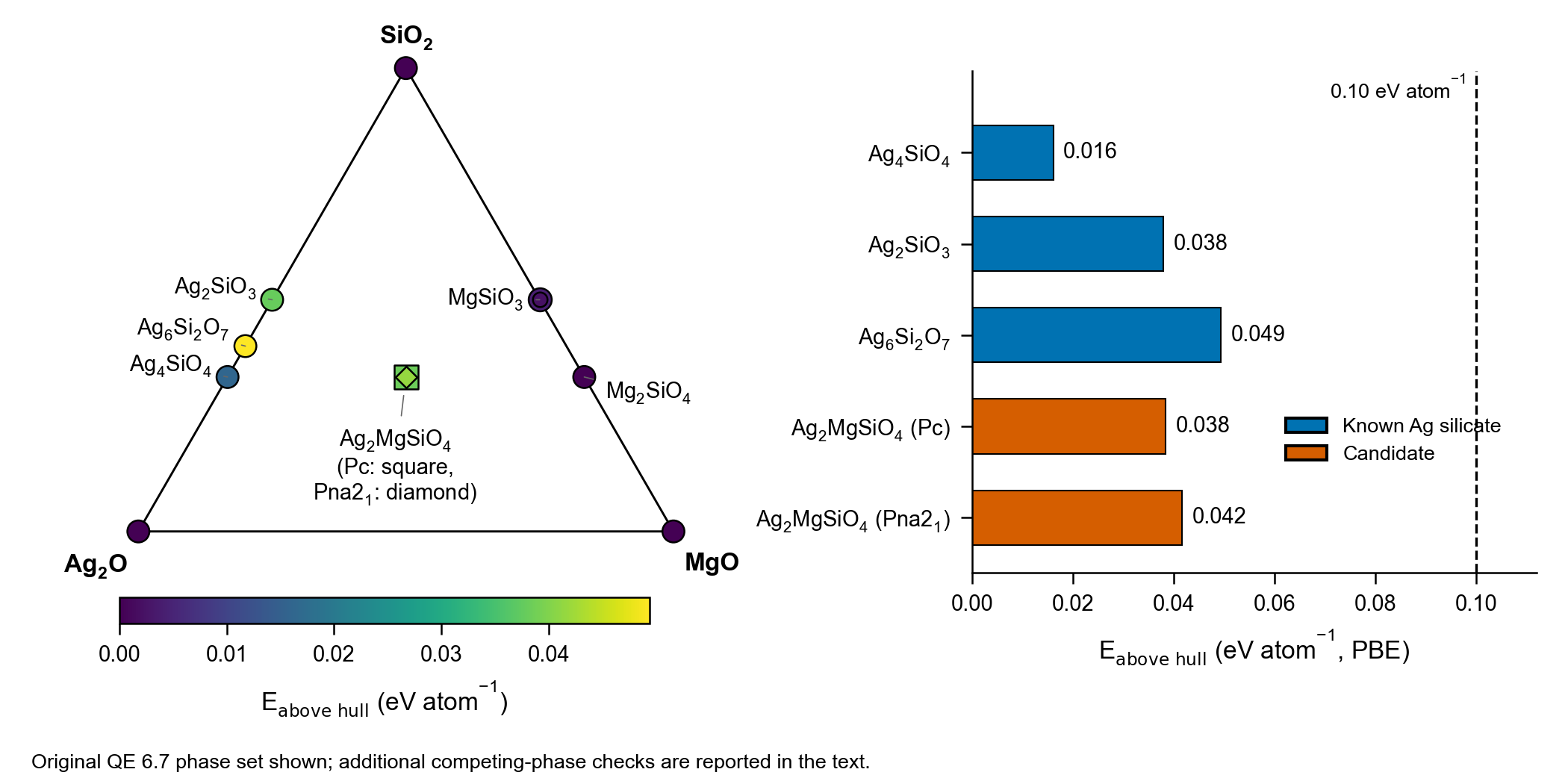
Restricted hull. Left: composition triangle coloured by PBE energy above the hull. Right: the two Ag₂MgSiO₄ polymorphs against known silver silicates, from the same calculation. The dashed line marks the lowest of the pre-specified metastability bands, a caution level and not a synthesis threshold. Original QE 6.7 phase set; the competing-phase checks are described in the text. Figure from the preprint; labels are in English.
Phonons: one structure, two code versions, opposite signs
Our first lattice-dynamics calculation (Quantum ESPRESSO 6.7, finite displacements in a 128-atom supercell) gave real frequencies at Γ, the lowest optical mode at +0.789 THz. At the zone-boundary point Z it gave two overlapping soft modes with a lowest frequency of −0.331 THz, just past the −0.3 THz tolerance we had written down in advance. By our own rule that could not be accepted as a stability claim, so we ran a frozen-phonon test along the soft mode. Energy fell by at most 0.0094 meV/atom and then rose. The rule's verdict was "undecided".
A later calculation with QE 7.4.1 gave a positive frequency. Because the cell and the code version had changed together, we separated them. In the same code (6.7), changing only the cell gave −0.384 THz instead of −0.331 THz. The same input in 7.4.1 gave +0.543 THz, and with the structure re-relaxed in 7.4.1, +0.567 THz. So the sign of the soft mode depends on the code version. Our inference is a known defect in how version 6.7 fixes the Fermi level with cold smearing, corrected in 6.8 (dos Santos and Marzari, 2023): for this insulator, 6.7 places the Fermi level at the valence-band maximum and leaves a partial occupation, while 7.4.1 places it in the gap. A numerical solution of the occupation condition from the printed eigenvalues reproduces the anomalous 6.7 root. We made no new fixed-occupation force calculation, so this stays an inference.
The audit then turned on our own frozen-phonon curve. At its deepest point the internal-energy change is +0.0693 meV/atom and the smearing contribution is −0.0786 meV/atom, larger than the total energy lowering, in a state with the same anomalous occupation. The numbers reproduce, but they cannot be read as a reliable stability test. We keep the curve as a non-diagnostic historical result.
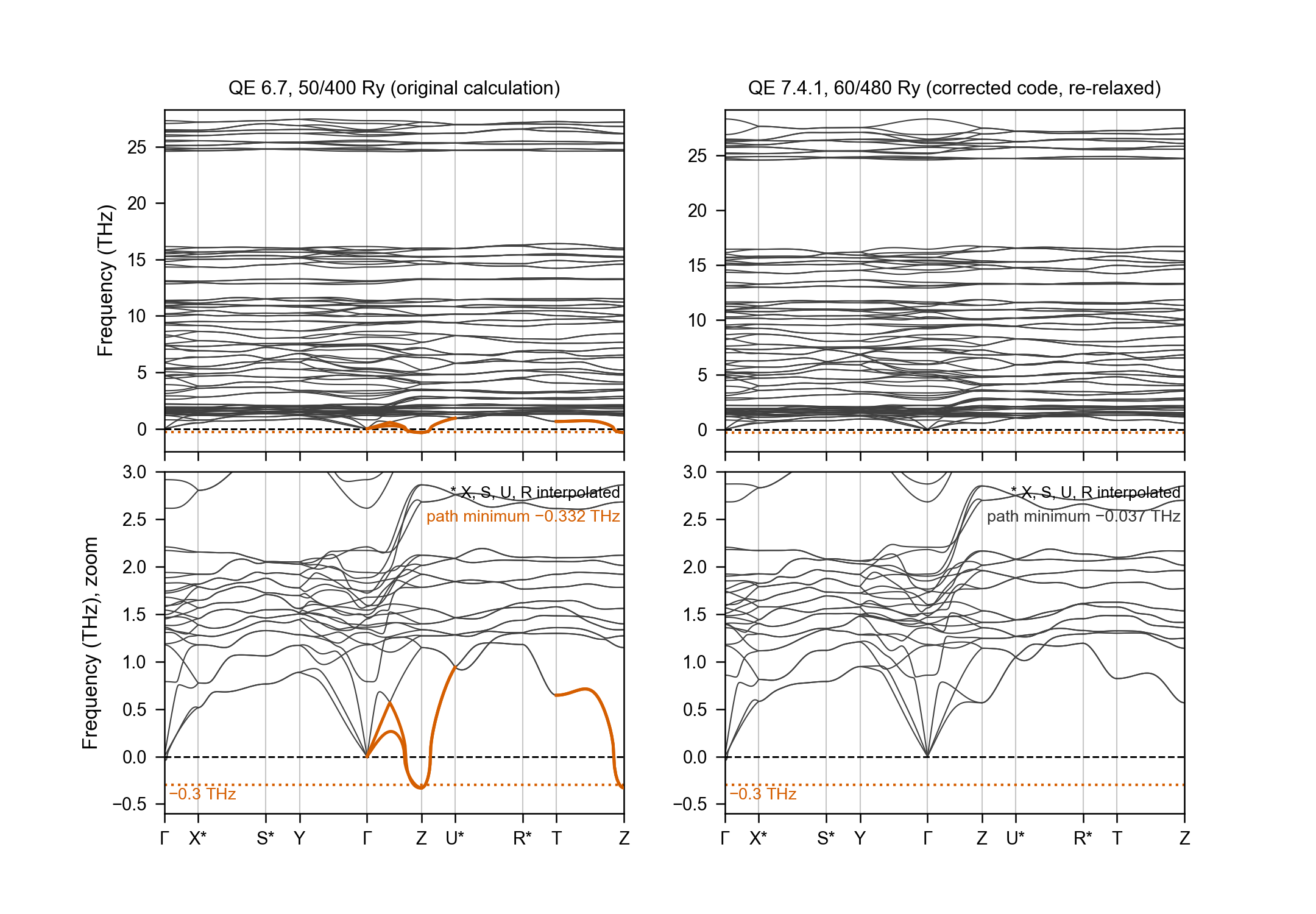
Phonon dispersion, two versions of the code. Left: QE 6.7, the first calculation, with the lowest branch highlighted. Right: QE 7.4.1 with the structure re-relaxed. Dotted: the −0.3 THz level set in advance. X, S, U and R are interpolated, because the supercell has no extension along a. The path minimum printed on the right panel (−0.037 THz) is a small negative acoustic interpolation value next to Γ whose convergence was not tested; the minimum on the sampled 20³ mesh is 0.000 THz. Figure from the preprint; labels are in English.
With the corrected code we repeated the full-zone calculation. On a 20³ mesh the lowest frequency is 0.000 THz (acoustic, at Γ) and 0 modes lie below −0.3 THz; at Z the lowest frequency is +0.567 THz. The original tolerance is met. What this supports is narrow: compatibility with harmonic stability for Pna2₁ at this supercell and sampling. Γ, Y, Z and T are commensurate with the supercell, but X, S, U and R, and most of the dense mesh, are Fourier-interpolated. We did not test k-mesh, displacement-amplitude or larger-supercell convergence, or LO–TO non-analytic corrections. The follow-up rule was written after the positive Z frequency was known, so this is an exploratory re-examination, not a prospective confirmation. The Pc polymorph has no DFT phonon calculation, and both MLIPs find it unstable.
What we withdrew, and why
| Earlier claim | Now |
|---|---|
| The compound absorbs at the violet edge of the visible range (HSE06 gap about 3 eV) | Withdrawn |
| Ag⁺ hop barriers comparable to or lower than a reported Ag⁺ conductor | Not established |
| Dynamically stable in the harmonic approximation | Narrowed to the sampled points and tolerance |
| Criterion checked against independent calculations | Descriptive agreement with correlated reference values, not independent samples |
| Criteria specified in advance | Documented decision criteria, not a prospective registration |
Light absorption. The earlier version shifted a hybrid-functional gap using one literature value. The raw HSE06 gaps are 2.597 (Pc) and 2.625 (Pna2₁) eV; adding a 0.363 eV shift, taken from the difference between one reported optical gap of Ag₂ZnGeO₄ (Li et al., 2008) and our computed gap for it (1.927 eV), gave 2.96 and 2.99 eV. The audit found that the exact-exchange grid we asked for was not the one used. The run used a 1×1×1 grid instead of the requested 3×2×2 (Pc) or 1×2×2 (Pna2₁), because the requested grids did not fit the electronic k meshes. In Quantum ESPRESSO that means one momentum-transfer value, q = 0, per electronic k point; it does not mean the electrons were computed at Γ only. Convergence with respect to this grid was never shown, and one reference compound does not calibrate a shift for another. All six sampled fundamental gaps are indirect, and the smallest direct gaps of the two candidates are 2.718 and 2.700 eV. A Tauc-derived optical gap and a sampled electronic fundamental gap are not the same observable, and no optical spectrum, transition strength, phonon-assisted absorption or exciton was calculated. We withdrew the claim. The gap remains an exploratory number.
Ion migration. For Pna2₁, the assumed saddle image in our DFT path calculation lies 0.022 eV below the higher-energy endpoint. The number we had called a barrier is therefore not a saddle barrier. The endpoint difference alone gives a lower bound of 0.220 eV, and a lower bound cannot show that this compound migrates more easily than the control. Beyond that, only the initial, middle and final images of each path were computed, in smaller cells, with a neutral silver vacancy that leaves an odd electron count in a non-spin-polarized calculation. For Pna2₁ the shortest distance between vacancy images in that smaller cell is 5.59 Å. The MLIP percolation thresholds are model comparisons: 0.246 eV for Pna2₁ and 0.335 eV for Pc, against 0.321 eV for Ag₂ZnSiO₄ and 0.251 eV for Ag₂BeSiO₄. They also do not discriminate, because Ag₂ZnGeO₄, reported as an electronic semiconductor, has a low threshold too (0.266 eV). None of this is a measured activation energy or conductivity.
What the audit was. An AI re-analysis of archived outputs: reparsing DFT files, redoing the energy arithmetic, re-analyzing phonon forces, regressing stress against strain, comparing electronic eigenvalues, and rebuilding path graphs. It ran no new DFT, no new MLIP inference, no paid compute, no synthesis, and it is not human peer review. We also checked our own review agents against the source. Several of their claims did not survive, among them a description of the exact-exchange run as an electronic calculation at Γ only and an argument that a barrier lower bound preserved an ordering, and we discarded them. Numerical reproduction of a stored output is not validation of the physics behind it.
What an experiment would test
The obvious experiment is a single exchange of Na₂MgSiO₄ with an excess of molten AgNO₃ at about 250–300 °C (Nalbandyan et al. used 570 K for Ag₂MnSiO₄; Li et al. 220 °C for 40 h for Ag₂ZnGeO₄), followed by washing, powder diffraction and elemental analysis of residual sodium. In the PBE-relaxed Pna2₁ structure the cell is a = 11.199 Å, b = 5.588 Å, c = 6.957 Å (volume 435.4 ų, density 5.07 g/cm³, in the standard setting). The strongest predicted reflection is at 2θ = 34.33° (Cu Kα), followed by a close pair at 31.97° and 32.03°. Positions carry an uncertainty of order 0.2° from the lattice, Na/Ag site mixing is neglected, and the hkl labels in the figure follow the supplied CIF's cyclically permuted axes, not the standard setting. A sample can be compared with these patterns only after its unit cell has been refined; the strongest peak depends on the polymorph (the Pc pattern differs, see the figure) and on the residual sodium content.
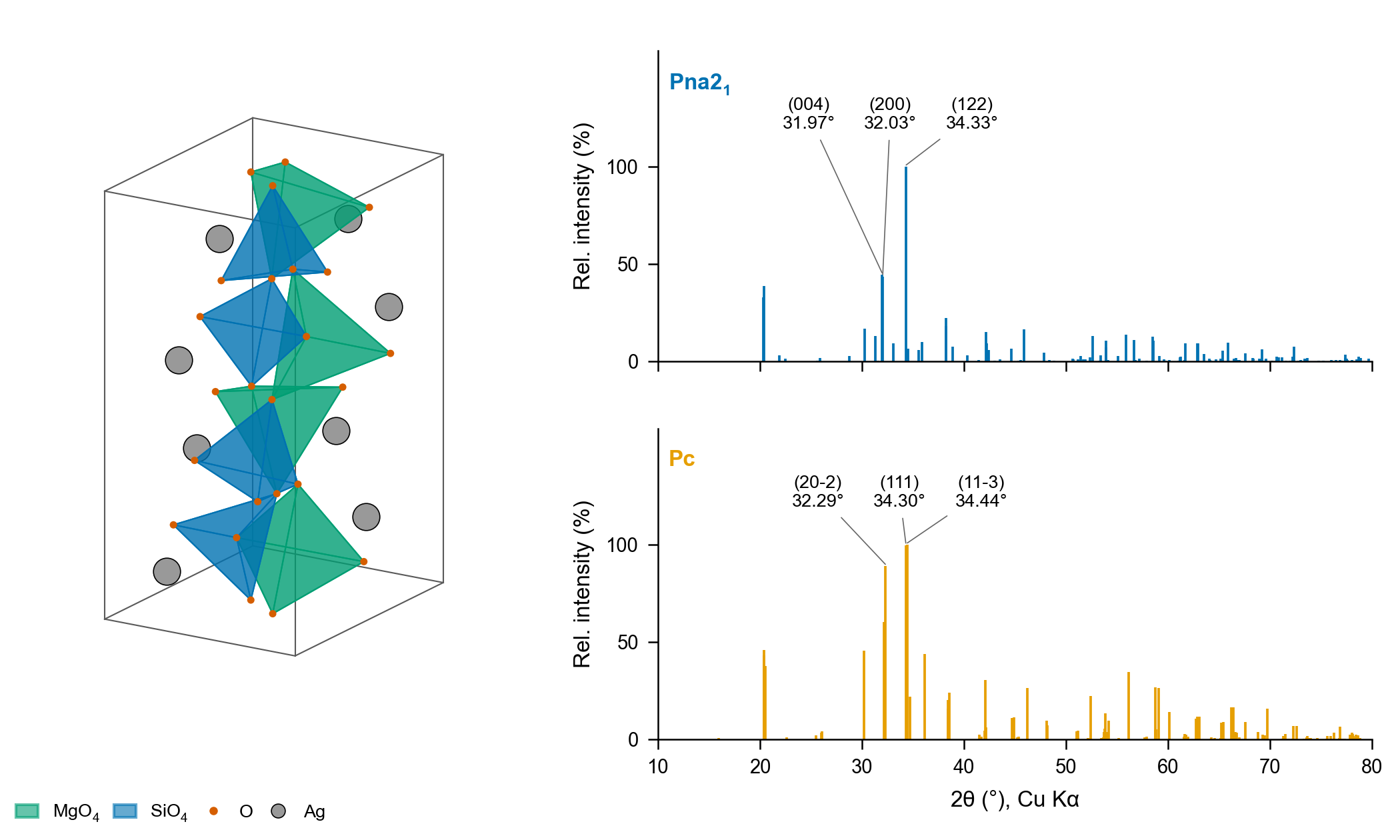
Predicted structure and powder patterns. Left: PBE-relaxed Ag₂MgSiO₄ (Pna2₁). Right: predicted X-ray patterns (Cu Kα) for the Pna2₁ and Pc polymorphs. Figure from the preprint; labels are in English.
The risks are real. The sodium conductivity of Na₂MgSiO₄ is only about 10⁻⁵ S/cm at 200 °C (Fernández-Carrión et al., 2021), so exchange may be slow or incomplete, as it was for the manganese compound. Vaivars et al. reported small amounts of metallic silver at higher temperatures, and the literature reports grain growth during these exchanges, so framework retention, which our energy model assumes, is itself something a synthesis would have to show. None of our energies includes vibrational free energy, the nitrate melt, or the activity of excess AgNO₃, and at these temperatures those terms can be comparable to the differences discussed here. A failed attempt under one set of conditions would not by itself exclude the compound.
Where the preprint stands
The preprint is on ChemRxiv, posted 5 October 2026: Computational assessment of a proposed Na⁺/Ag⁺ ion-exchange route to Ag₂MgSiO₄, a predicted wurtzite-derived silver silicate (DOI 10.26434/chemrxiv.15009838/v1). This post follows that version, and its abstract carries the corrected claims described above.
Relaxed structures, numerical results and the calculation data needed to inspect the reported results are available from us on request, and raw DFT outputs are retained with SHA-256 checksums. The preprint does not claim a public data-repository deposition, and the harness code is proprietary.
Research harness and AI use. This work used AI3 Discovery's scientific research harness, operated with an AI coding assistant (Claude, Anthropic), to write and run workflow scripts, nominate the candidate, evaluate it against recorded criteria, draft and revise the manuscript, and run automated review passes. Those reviews were performed by AI and are not independent human peer review. The audit described above reparsed archived outputs and did not rerun the electronic-structure calculations. AI3 Discovery develops the harness and is responsible for the published content.
| Explore what AI can make possible in your research |
|---|
| AI holds enormous potential for scientific research. AI3 Discovery welcomes researchers and laboratories interested in putting that potential to work through collaborative research. If you can run a molten-salt ion-exchange experiment, or you have a scientific question, a dataset to investigate, or an experiment to connect with computational analysis, we would like to hear from you. Contact: discovery@ai3.kr |
Sources and scope
- Vaivars G, Grins J, Hörlin T. Synthesis, structure and conductivity of Ag₂ZnSiO₄, Ag₂ZnGeO₄ and Ag₂BeSiO₄. Solid State Ionics 78, 259–267 (1995). doi:10.1016/0167-2738(95)00000-V
- Nalbandyan VB et al. A₂MnXO₄ family (A = Li, Na, Ag; X = Si, Ge): structural and magnetic properties. Inorg. Chem. 56, 14023–14039 (2017). doi:10.1021/acs.inorgchem.7b02130
- Suzuki I, Kita M, Omata T. Designing topotactic ion-exchange reactions in solid-state oxides through first-principles calculations. Chem. Mater. 36, 4196–4203 (2024). doi:10.1021/acs.chemmater.3c03016
- Baur WH, Ohta T, Shannon RD. Structure of magnesium disodium silicate Na₂MgSiO₄ and ionic conductivity in tetrahedral structures. Acta Cryst. B 37, 1483–1491 (1981). doi:10.1107/s0567740881006419
- Fernández-Carrión AJ et al. Sodium site exchange and migration in a polar stuffed-cristobalite framework structure. Inorg. Chem. 60, 4322–4331 (2021). doi:10.1021/acs.inorgchem.1c00319
- Li X, Ouyang S, Kikugawa N, Ye J. Novel Ag₂ZnGeO₄ photocatalyst for dye degradation under visible light irradiation. Appl. Catal. A 334, 51–58 (2008). doi:10.1016/j.apcata.2007.09.033
- dos Santos FR, Marzari N. Fermi energy determination for advanced smearing techniques. Phys. Rev. B 107, 195122 (2023). doi:10.1103/PhysRevB.107.195122
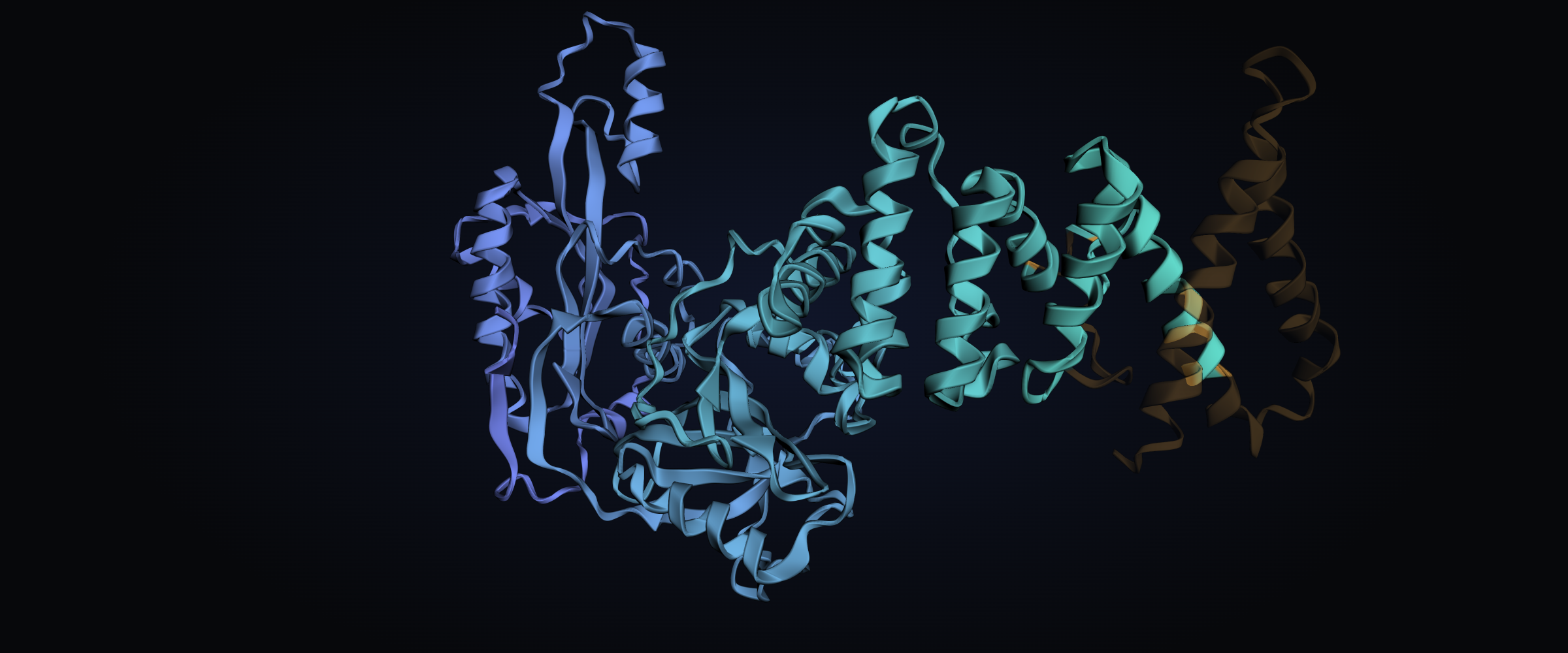
The result values in this post were filled in by code from the revision's generated numbers file rather than typed by hand. The cover image is a rendering of the computed PBE-relaxed Ag₂MgSiO₄ (Pna2₁) cell (MgO₄ tetrahedra in mint, SiO₄ in blue, Ag in silver, axes permuted for display, colors as in the figures above); it is a prediction, not an experimental structure. No synthesis or property measurement was performed.