AI3 Discovery has set a new state of the art on the Human Connectome Project (HCP) cognition-prediction benchmark. How accurately a brain scan can predict a person's cognitive ability is a long-standing question for neuroscience and psychiatry, and for research on ageing, dementia and development. AI3 Discovery surpassed the best result on the most widely used public benchmark for it, and then showed that the performance holds in people the method had never seen.
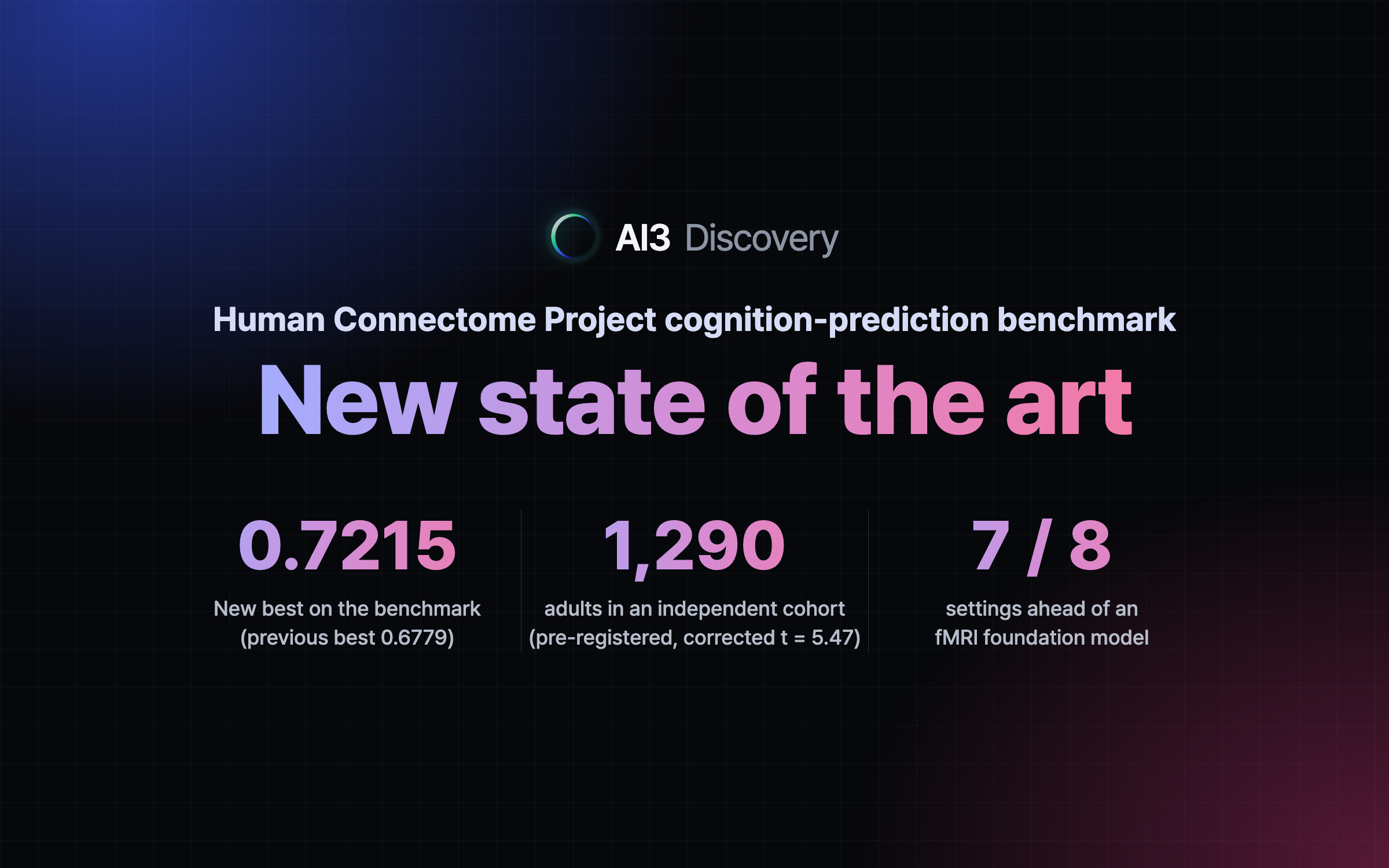
- A new best on the benchmark: r = 0.7215, above the best model reported in the benchmark paper (0.6779).
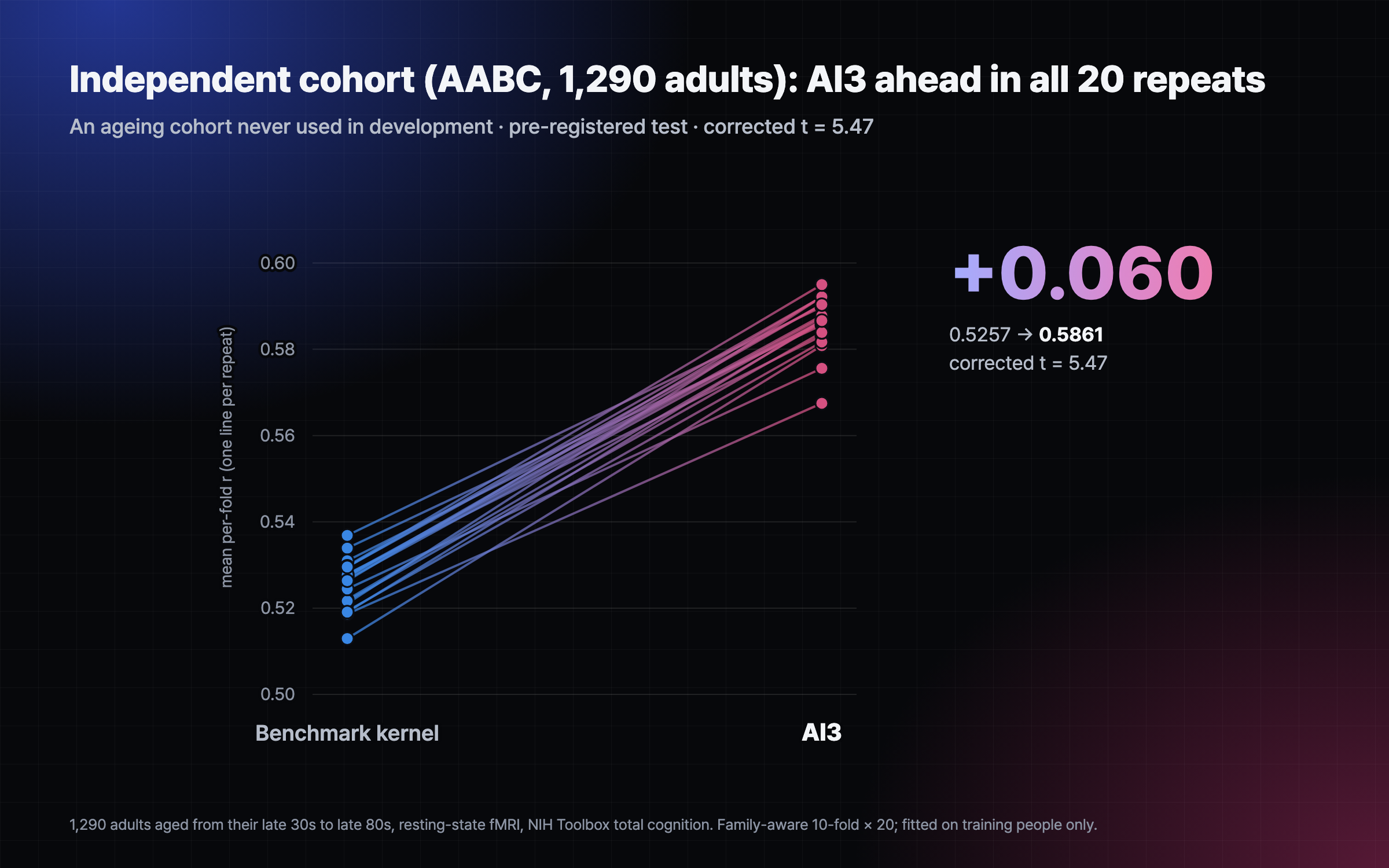
- Confirmed in an independent cohort: in 1,290 adults of an ageing cohort never used in development, the method passed a test registered in advance (corrected t = 5.47).
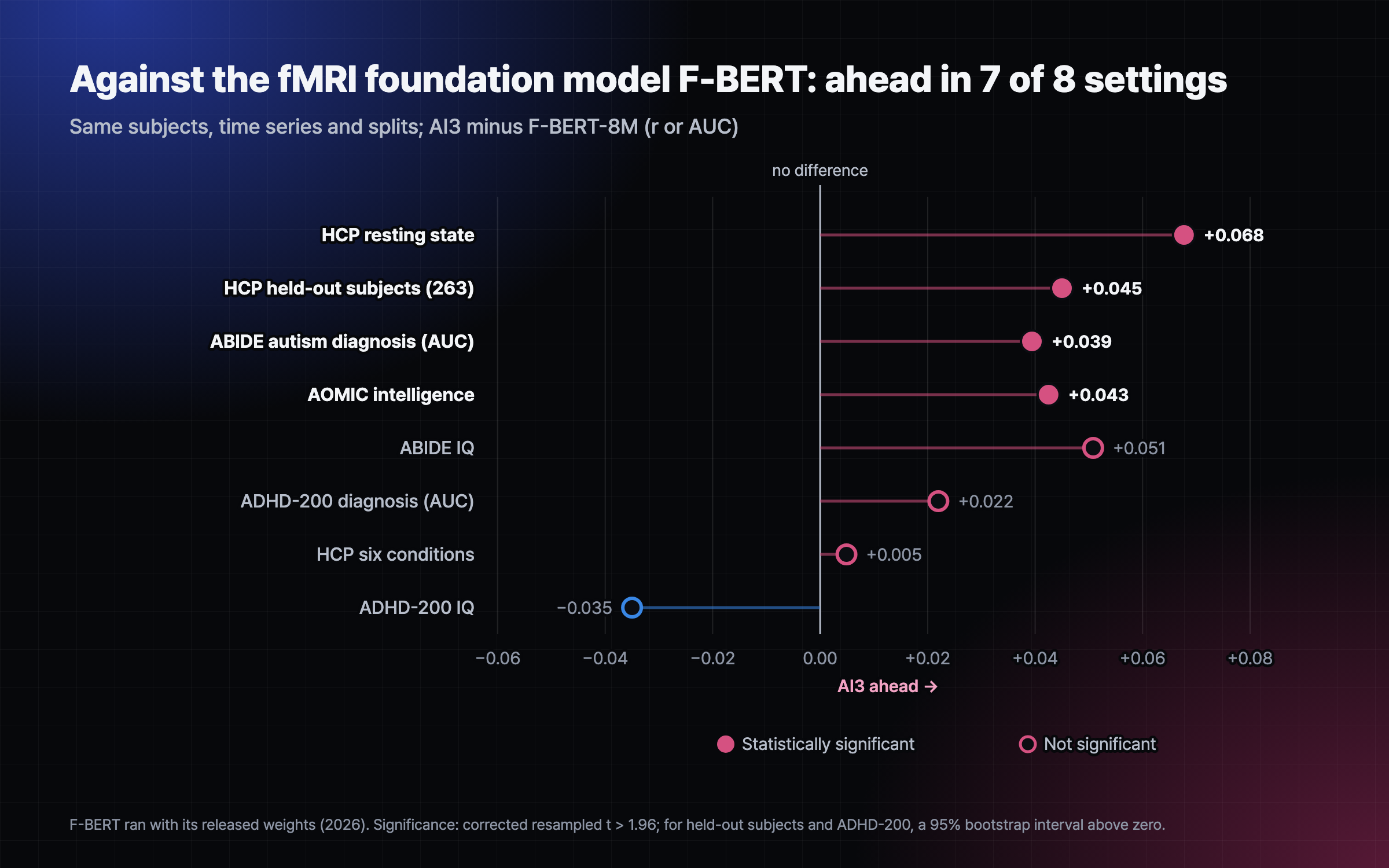
- Ahead of a foundation model: compared with F-BERT, an fMRI foundation model released in 2026, under identical conditions, AI3 Discovery's method was ahead in 7 of 8 settings.
AI3 Discovery carried out this work as non-commercial academic research, and the code, result files and pre-registrations are public.
What is the Human Connectome Project?
The Human Connectome Project (HCP) is a large brain-mapping effort funded by the US National Institutes of Health (NIH) and led by Washington University in St. Louis and the University of Minnesota. A connectome is the full wiring diagram of the brain: how its regions are connected and work together.
The HCP scanned more than 1,200 healthy adults aged 22 to 35, including twins and siblings, with high-resolution MRI. For each person it recorded several hours of data: brain activity at rest (resting-state fMRI), activity during tasks such as language, working memory and social cognition (task fMRI), and the paths of nerve fibres (diffusion MRI). Cognitive and behavioural test results of the same people are released alongside the scans.
That combination made the HCP the standard proving ground for one question: can brain connectivity predict individual traits? Because research groups around the world compete on the same data, performance on the HCP is the reference point for comparing methods.
The benchmark: predicting cognition from brain connectivity
AI3 Discovery took on the HCP connectome-to-cognition benchmark published in NeuroImage in 2022 by researchers at the National University of Singapore (Ooi et al.). It provides the functional connectivity (FC: a matrix of how strongly the activity of each pair of brain regions rises and falls together) of 753 people under six fMRI conditions, resting state and five tasks, and asks for each person's overall cognition score.
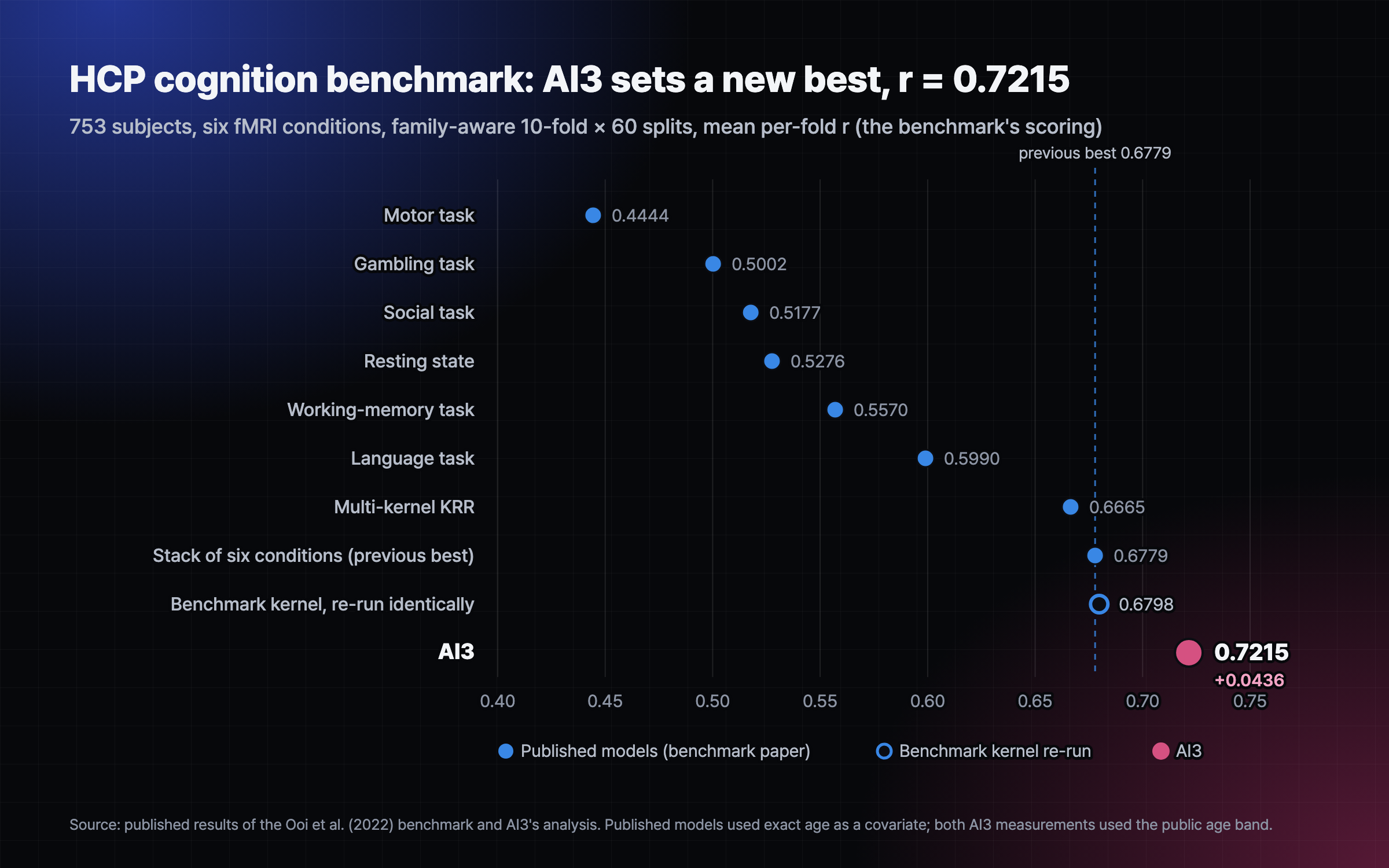
The evaluation is strict. Ten-fold splits that keep families together are repeated 60 times. In each fold the correlation (r) between predicted and observed scores is computed, and the folds are averaged. Age and sex are regressed out within the training data. The field's standard predictor is kernel ridge regression (KRR), and the best model reported in the benchmark paper, a stack of the six conditions, reached r = 0.6779.
The result: r = 0.7215, a new best on the benchmark
On the same subjects, the same splits and the same scoring as the benchmark paper, AI3 Discovery's method reached r = 0.7215.
- That is 0.0436 above the benchmark paper's best model (0.6779): 6.4% higher in correlation, and 13% more variance explained (r²).
- For a like-for-like comparison, AI3 Discovery also re-ran the benchmark's own kernel method under identical conditions (0.6798). The margin of 0.0417 over it is statistically significant: t = 3.23 in the Nadeau–Bengio corrected resampled t-test, which accounts for the subjects that repeated splits share.
- AI3 Discovery's method was ahead in all 60 repeated splits.
That is a new state of the art on this benchmark.
It holds in 1,290 people it had never seen
A record on a benchmark is one thing; working for people the method has never seen is another. AI3 Discovery answered the second question too.
The Aging Adult Brain Connectome (AABC) is an NIH-funded study, supported by the National Institute on Aging, that carries the Human Connectome Project into middle and late adulthood. Building on the Human Connectome Project in Aging (HCP-A), it scans adults with HCP-style MRI at four US sites (Washington University in St. Louis, the University of Minnesota, Massachusetts General Hospital and UCLA) and follows them over time.
AI3 Discovery had never used these data while developing the method. It registered the decision rule before the analysis and ran the test once. The cohort was 1,290 adults aged from their late 30s to their late 80s at four sites, and resting-state connectivity alone was used to predict the NIH Toolbox total cognition score. The model was fitted on training people only and then applied to people it had never seen.
The result: AI3 Discovery's method reached r = 0.5861 against 0.5257 for the benchmark's kernel method.
- That is 0.060 higher: 11% higher in correlation, and 24% more variance explained (r²).
- The difference is highly significant: corrected t = 5.47 (p = 1.3 × 10⁻⁷).
- AI3 Discovery's method was ahead in all 20 repeated splits.
The pre-registered test was met. A method built on a benchmark of young adults carried over to a cohort that differs in age, scanning sites and data processing.
Ahead of a foundation model, too
AI3 Discovery also compared the method head to head with F-BERT, an fMRI foundation model released in 2026: a transformer encoder pre-trained on a large fMRI corpus. Both ran on the same subjects, the same time series and the same splits, with F-BERT's released weights.
Across eight settings, including held-out HCP subjects and three other cohorts covering intelligence, autism diagnosis and ADHD, AI3 Discovery's method was ahead in seven, and significantly so in four. On resting-state fMRI alone, for example, it reached r = 0.5913 against 0.5235 for F-BERT-8M: 13% higher, with a corrected t of 3.88, and ahead in all 60 splits. It did so with closed-form mathematics rather than a neural network with millions of pre-trained parameters.
How it works: refine each connectome, read the structure of the group
AI3 Discovery's method has two stages.
Stage 1: conditioning each person's connectome. A single person's connectivity matrix is noisy, and the correlation between two regions mixes direct links with indirect ones through other regions. AI3 Discovery stabilises each correlation matrix by shrinkage and converts it into partial correlations (the direct link between two regions once all others are accounted for). It then re-weights the eigenvalues and mixes back a little of the full correlation, giving a connectome that is less sensitive to noise. Because it works on each person separately, it applies directly to new people, and it is the stage that carried the gain into the independent cohort.
Stage 2: a spectral filter on the between-subject kernel. From the similarity of connectomes between people, AI3 Discovery builds a kernel and filters out the weak directions of its eigen-spectrum. It never uses the target scores, only the connectivity structure of the group, which suits research cohorts in which the scans of everyone to be assessed are available together.
On the HCP benchmark the two stages are strongest together. In AI3 Discovery's factorial experiment, the filter raised accuracy substantially on conditioned connectomes, and the interaction was clearly significant (t = 3.47): denoising at the level of the individual and learning structure at the level of the group complement each other.
Built to be checked
- The benchmark's own scoring. AI3 Discovery showed that the same predictions can score very differently depending on scoring choices, sometimes enough to reverse the ranking of methods. Every comparison therefore follows the benchmark paper's own procedure.
- Pre-registration. The main tests, including the independent-cohort test, had their decision rules fixed and recorded before the results were seen.
- Open code and results. Code, fold-level results and pre-registrations are on GitHub and archived at Zenodo (DOI 10.5281/zenodo.24355565). The public files reproduce every number in the paper. No participant-level data are shared.
Why it matters
Reading cognitive ability accurately from brain imaging is a long-standing goal of human neuroscience. Sharper connectivity-based measures can make studies of how cognition changes with age, of the early stages of cognitive decline, and of development and psychiatric conditions more precise. These results show that the gain is not confined to young adults on one benchmark: it carries over to an older, more varied population scanned at several sites.
Open research
AI3 Discovery carried out this study as non-commercial academic research and shares it openly. Researchers are welcome to reproduce it, test it on their own cohorts and build on it. Questions and reports are welcome on the project's GitHub page.
Data and acknowledgements
HCP data were used under the WU-Minn HCP Open Access Data Use Terms, and AABC data under the AABC Consortium Data Use Terms. Neither dataset is redistributed.
- Data were provided [in part] by the Human Connectome Project, WU-Minn Consortium (Principal Investigators: David Van Essen and Kamil Ugurbil; 1U54MH091657) funded by the 16 NIH Institutes and Centers that support the NIH Blueprint for Neuroscience Research; and by the McDonnell Center for Systems Neuroscience at Washington University.
- Data, methods used, and/or research reported in this publication were provided in whole or in part by the Aging Adult Vulnerability and Resiliency in the Aging Adult Brain Connectome (AABC) project (U19AG073585) and the Human Connectome Project in Aging (HCP-A, U01AG052564) funded by the National Institute of Aging of the National Institutes of Health. HCP-A was further supported by funds provided by the McDonnell Center for Neuroscience at Washington University in St. Louis.
References: Van Essen DC et al. (2013), The WU-Minn Human Connectome Project: an overview, NeuroImage 80:62–79 (doi). Bookheimer SY et al. (2019), The Lifespan Human Connectome Project in Aging: an overview, NeuroImage 185:335–348 (doi). Ooi LQR et al. (2022), Comparison of individualized behavioral predictions across anatomical, diffusion and functional connectivity MRI, NeuroImage 263:119636 (doi).
This post describes AI3 Discovery's non-commercial academic research. Nothing here is medical advice.