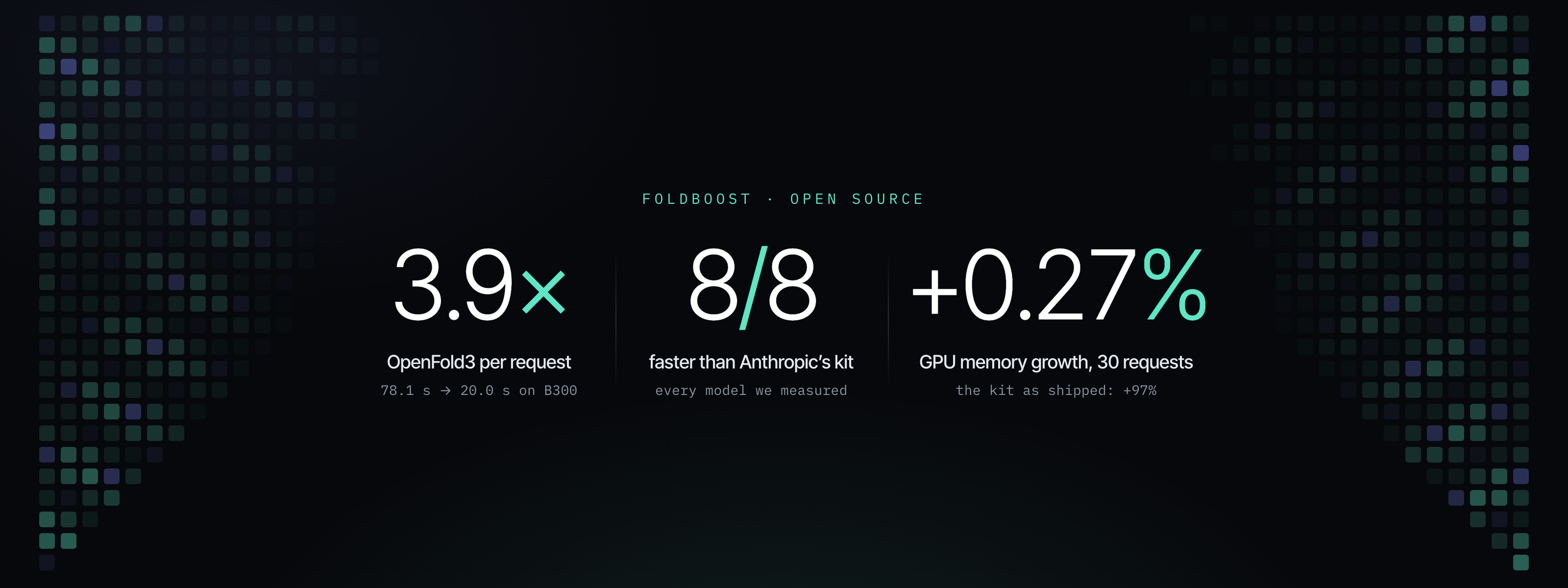
Anthropic released an inference kit that runs 36 biomolecular models, including OpenFold3, Boltz-2, Protenix and ProteinMPNN, several times faster than their original releases. This is optimization work by a frontier AI lab. AI3 took that kit as a starting point and pushed it further. Today we are open-sourcing the result as FoldBoost.
- Faster than Anthropic's kit on all eight models we benchmarked, with outputs byte-identical to Anthropic's kit in the same mode.
- Run as a server, the gap widens. On a B300, one OpenFold3 request takes 78.1 s with the original release, 34.2 s with Anthropic's kit and 20.0 s with FoldBoost.
- We found and fixed a GPU memory leak in the kit. Memory in a long-running server kept growing; FoldBoost stops it without editing the kit (+97% → +0.27%).
| Kit | Repository |
|---|---|
| Anthropic's kit (the original) | anthropics/uplifting-biomolecular-modeling · announcement |
| FoldBoost (AI3, released today) | ai3inc/foldboost · Apache-2.0 |
All eight models, faster than Anthropic
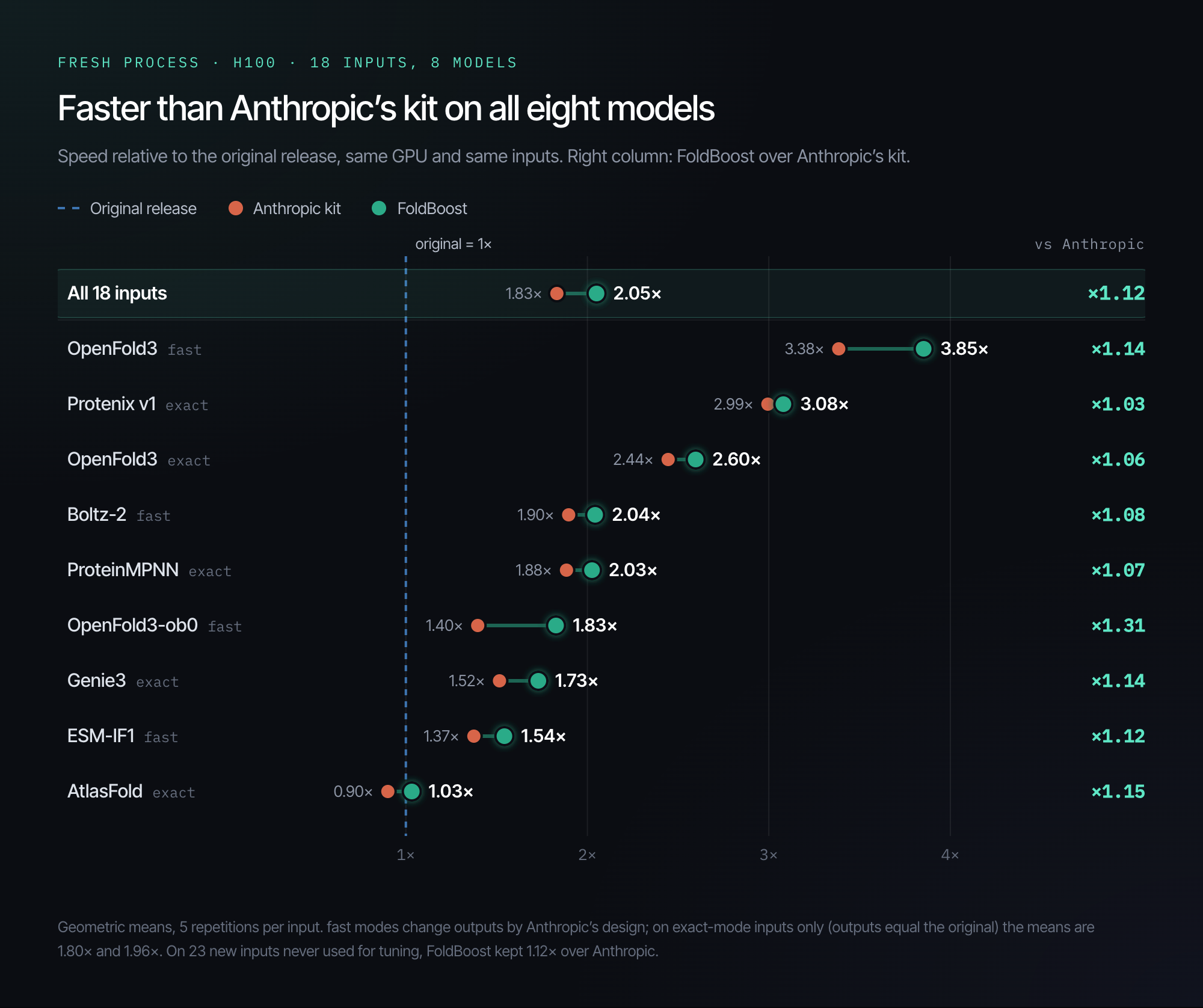
We ran the original release, Anthropic's kit and FoldBoost once each in a fresh process, on the same H100 with the same inputs. Across 18 inputs, Anthropic's kit is 1.83× faster than the original and FoldBoost is 2.05×. FoldBoost leads on every one of the eight models; the widest margin is OpenFold3-ob0, 1.31× faster than Anthropic's kit. On 23 new inputs never used for tuning, the 1.12× lead over Anthropic held.
AtlasFold is worth a look. There, Anthropic's exact mode is actually slower than the original (0.90×). FoldBoost's router knows this from its measurements, and for any input it has measured it picks the fastest of the original release, Anthropic's mode and FoldBoost's adapter.
3.9× faster as a server
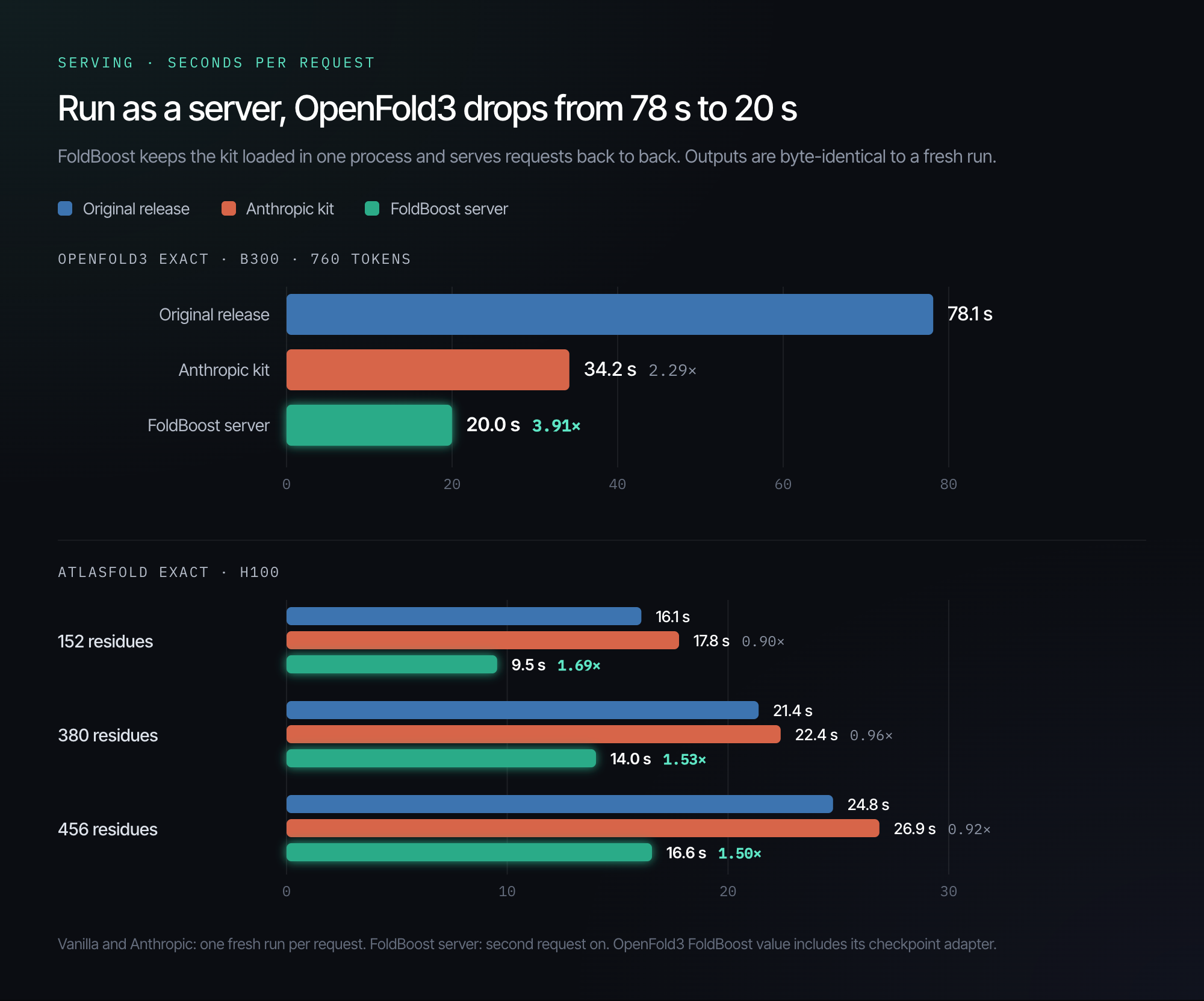
Anthropic's kit is a command-line tool that starts a new process for every request, so every request pays for imports, GPU initialization and checkpoint loading again. FoldBoost keeps the kit's own function loaded in one process and serves requests back to back. Start-up is paid once, and outputs are byte-identical to a fresh run.
The difference shows up as soon as requests keep coming. On a B300, one 760-token OpenFold3 request goes from 78.1 s with the original release to 20.0 s with FoldBoost: 3.9× faster than the original and 1.7× faster than Anthropic's kit. Per request against Anthropic's kit, OpenFold3 is 1.4–1.8× faster (H100), AtlasFold 1.6–2.0× (H100) and OpenFold3-ob0 1.9–2.0× (B300).
A memory leak in the kit, found and fixed
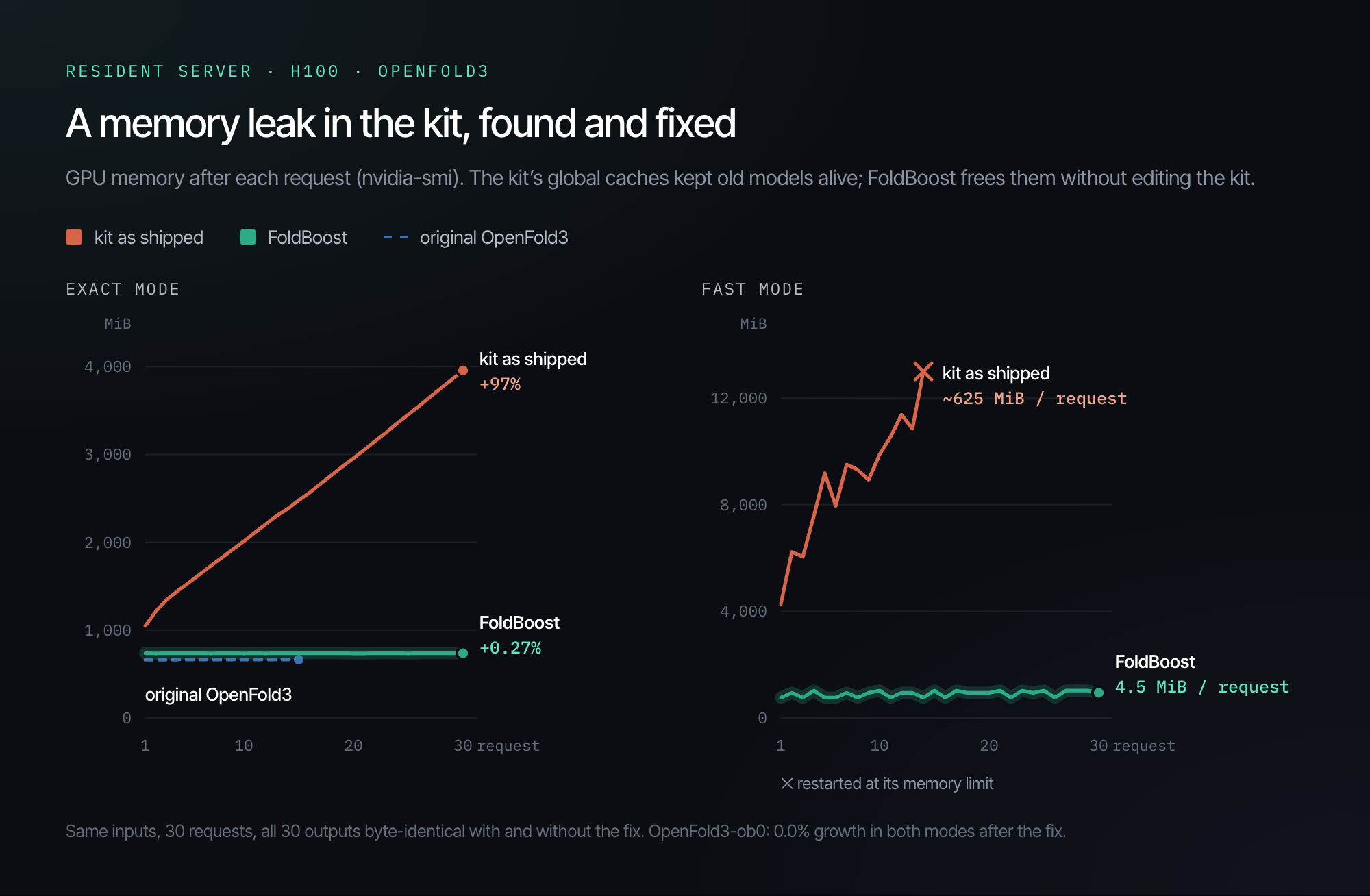
While testing the resident server we found a defect in Anthropic's kit itself. On an H100, an OpenFold3 server grew GPU memory by about 97 MiB with every request, nearly doubling within 20 requests. In fast mode it grew about 625 MiB per request, and the server hit its memory limit and restarted at request 14.
The cause was the kit's global caches. The of3_transition cache of packed weights, and several others, held on to every model they had ever seen. A command-line run exits, so nobody noticed; a server that keeps taking requests piles it all up. Upstream OpenFold3 called the same way in a loop stays flat.
FoldBoost frees those caches from the server side without changing a line of the kit. Over the same 30 requests, memory growth went from +97% to +0.27% in exact mode and from 625 MiB to 4.5 MiB per request in fast mode, and OpenFold3-ob0 is at 0.0% in both modes. All 30 outputs stay byte-identical and the speed-up stays. We also published a patch that can go straight into the kit, in docs/kit-patches.
What FoldBoost is made of
- A router. For each request it reads archived measurements and picks the fastest of the original release, Anthropic's mode and FoldBoost's adapter. It keeps the exact or fast mode you chose, and sends inputs it has not measured to Anthropic's mode.
- A resident server. It keeps the kit loaded in one process and serves requests back to back. The memory release above lives here.
- Eight adapters. They remove costs that repeat in every process: checkpoint loading, a Triton fingerprint, a CIF parser, worker start-up. If an output differs by a single byte, the adapter is not used.
None of this touches model code. FoldBoost sits on top of Anthropic's kit as it is, so if you already run the kit you can add it directly.
How we measured
Every number is a measurement of the original release, Anthropic's kit and FoldBoost side by side, on the same GPU with the same inputs (H100 and B300). We wrote the plans and pass criteria before measuring, and the repository holds those plans, the raw data, the analysis code and the status of all 36 kits. The speed-up comes from time outside the model's math (start-up, repeated loading, memory), and the resident server gains most on models whose kit runs the model in-process, such as OpenFold3 and AtlasFold.
Try it
git clone https://github.com/ai3inc/foldboost.git && cd foldboost
python -m foldboost verify      # checks the policy digest and the 8 adapters
python -m foldboost coverage    # what is supported, per model
Installation and serving are in the repository README. FoldBoost is Apache-2.0. The kits, modes and common runtime are Anthropic's; FoldBoost is not affiliated with or endorsed by Anthropic.
If you run biomolecular models as a service, put FoldBoost on top. To compare measurements or collaborate, get in touch with AI3 Discovery.