Glioma is a brain tumour that arises from the supporting cells of the brain. Its most malignant form, glioblastoma, leaves few options once it recurs. Patients and clinicians have to choose each new line of treatment without a reliable sign of who it will help.
The obvious route has been to pick patients by a molecular marker and give them a drug aimed at cell division. In recurrent glioblastoma, trials of that kind have ended with insufficient efficacy. The tumours are also not alike: two gliomas can look the same under the microscope and still lean on different survival genes to stay alive.
The question behind this research is whether a patient group can be defined by the survival genes its tumour cells depend on, so that an existing drug is tested only in that group, and whether that dependency can be read from data that already exist.
Why it is hard today
In recurrent glioblastoma, trials that chose patients by a molecular marker and gave them a CDK4/6 inhibitor (a drug that blocks the cell-division enzymes CDK4 and CDK6) did not reproduce efficacy in three prespecified studies. A phase 2 trial of palbociclib in patients positive for RB protein stopped early for lack of efficacy, and 95% of evaluable patients progressed within six months. A phase 2 trial of abemaciclib reported a 6-month progression-free survival of 9.37%.
Three problems sit behind those results.
- The marker is weak. Gene amplification of CDK4 did not translate into drug response.
- The target is everywhere. The cell-division enzymes are essential in nearly all cancer cell lines, so a drug aimed at them can also act on normal cells.
- The data disagree. The same cell line can read as sensitive in one data release and resistant in another.
The result is that patients spend time on treatments that do not work, clinicians have no criterion for choosing, and developers carry the cost of failed trials.
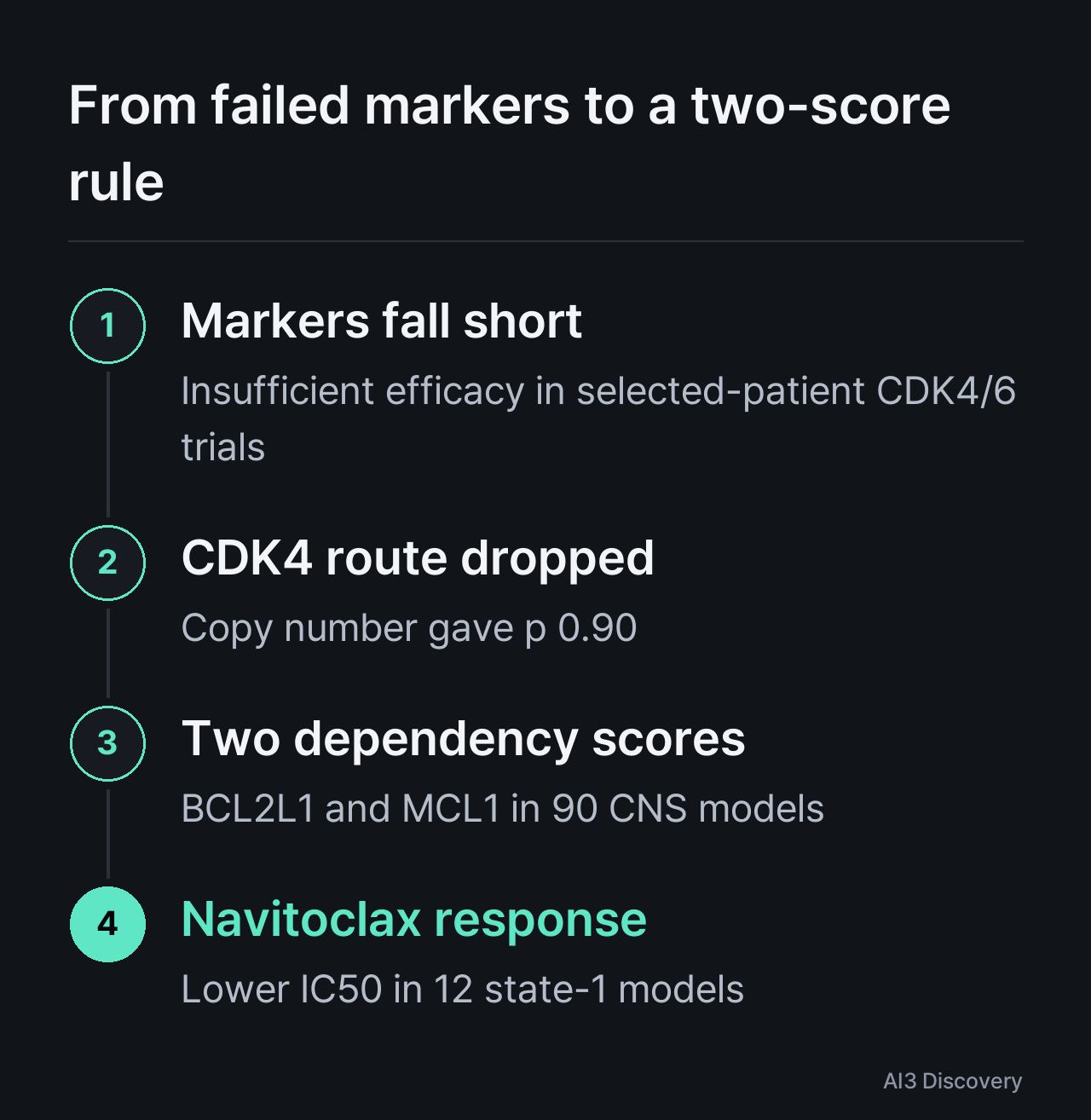
Figure 1. From failed markers to a two-score rule. How the study moved from a failed marker to a two-score selection rule.
Where the idea came from
The study began with a different invention: a combination of a CDK4/6 inhibitor and a PARP inhibitor for glioblastoma with CDK4 amplification. AI3 Discovery analysed it on BioQ, its bio research platform that holds 97 public biological databases, checked against their originals and cross-linked in one place. The analysis did not support the combination. Selection by CDK4 amplification was contradicted by the data, and PARP1 dependence was present in only 3 of 90 central nervous system (CNS) models. AI3 Discovery dropped the combination.
In DepMap (gene dependency, expression and copy number of cancer cell lines), the same 90 CNS/Brain models showed a different pattern: 71 depended on BCL2L1, 66 on MCL1, and none on BCL2. BCL2L1 encodes BCL-XL, a protein that keeps cells from dying. Navitoclax is an oral small molecule that blocks BCL-XL. The frequent BCL2L1 dependency led AI3 Discovery to ask whether navitoclax could be matched to patients by their BCL2L1 and MCL1 dependency scores, and to evaluate that rule.
Earlier studies fit this picture. Vogler 2025, a review, reports that navitoclax works in models that depend on BCL-XL and express little MCL1, and links navitoclax response to BCL2L1 gene dependency across cancers. Its Chronos dependency scores appear as average scores per cancer type and box plots. Vera 2022 shows in patient-derived glioma stem cells that the effect of BCL-XL inhibition is tied to Mcl-1 activity and Noxa expression. Koessinger 2022 reports that CRISPR removal of MCL-1 raises navitoclax sensitivity in glioblastoma. Tagscherer 2008, which AI3 Discovery read as an abstract only, reports that lowering Mcl-1 raises sensitivity to ABT-737 and that stem-cell resistance goes with high Mcl-1.
The closest of these already describes the principle of BCL-XL dependence with low MCL1. None of them contains a score threshold that separates a naturally MCL1-independent patient group in glioma.
How AI3 Discovery tested it
AI3 Discovery compared four ways of narrowing the patients, on the same models and the same platform. The CNS/Brain cell lines with a navitoclax dose-response curve numbered 43 in GDSC1 (drug sensitivity of cancer cell lines), 43 in GDSC2, and 27 in each of two PRISM screens (MTS010 and HTS002, drug repurposing screens across cell lines). AI3 Discovery treated the two PRISM screens separately. All p-values below are unadjusted for multiple comparisons.
| Idea | Test | Result |
|---|---|---|
| CDK4 copy number 6 or more | GDSC1 IC50 median 9.76 vs 9.99 µM, p 0.90 | Not supported |
| RNA expression (BCL2L1 high, MCL1 low; NOXA) | GDSC1 IC50 p 0.28 and 0.24 | Not supported; PRISM MTS010 only (p 0.0051) |
| BCL2L1 dependency score alone | GDSC1 IC50 p 0.0305, selected median 5.51 µM | Nominal association in GDSC1; close to earlier work |
| Two dependency scores together | GDSC1 IC50 median 3.55 vs 15.46 µM, permutation p 0.0131 | Adopted candidate; nominal GDSC1 association, inconsistent across data sets |
The CDK4 route failed cleanly. Moving the copy-number threshold anywhere between 3 and 12 did not separate responders from non-responders, so AI3 Discovery dropped it. The expression-based rules separated the groups in one PRISM screen and in neither GDSC1 test. AI3 Discovery did not build on them.
A BCL2L1 score alone does separate the groups in GDSC1, and it is an independent criterion. AI3 Discovery's record states plainly that it is also close to the principle Vogler 2025 already describes. The two-score rule is the one AI3 Discovery adopted.
CCLE proteomics (protein levels in cancer cell lines) could have offered a protein-level read of BCL2L1 and MCL1. Only 11 CNS models had protein values, so AI3 Discovery did not use them for the comparison.
What AI3 Discovery found
The proposed selection rule would be applied to cells grown from a patient's own tumour. A patient would be assigned to state 1 when the BCL2L1 Chronos score (a gene-dependency score; the more negative, the more the cells depend on the gene) is -0.5 or lower and the MCL1 score is higher than -0.5. If the rule is validated, patients in state 1 would be the group in which a navitoclax composition is used. CDK4 amplification is deliberately not used for selection.
AI3 Discovery applied the rule to the CNS/Brain models in DepMap, which are the analysed cohort, and compared drug response in GDSC1. The glioma application is the proposed use; the cohort itself is not glioma-only. Twelve models met state 1. Their median IC50 (the drug concentration that cuts cell growth by half) for navitoclax was 3.55 µM. The other 31 models had a median of 15.46 µM. These IC50 values are calculated estimates, and many lie beyond the tested concentrations. The difference is nominally significant by a rank-sum permutation test (p 0.0131, unadjusted). Among the 90 CNS/Brain models, 18 depend on one of the two genes only, so a group to select exists.
Two checks changed AI3 Discovery's earlier reading. The DBTRG-05MG model has a CDK4 copy number of 7.0 in the DepMap engine, so it is amplified, not non-amplified as first read. Of the 7 models with copy number 6 or more, this is the only one in state 1. That directly supports the statement that CDK4 amplification alone does not select responders. AI3 Discovery also separated the two PRISM screens, which an earlier working figure had mixed.
In ClinicalTrials.gov, queries for navitoclax and its synonyms ABT-263 and A-855071.0 under glioma, glioblastoma and brain returned zero registered trials in the 2026-10-30 data snapshot.
The selection rule uses dependency scores, not expression or amplification. That is what is new against the closest earlier work: a two-score dependency threshold applied to cultures derived from the tumours of glioma patients, with response compared on a reference panel within one platform.
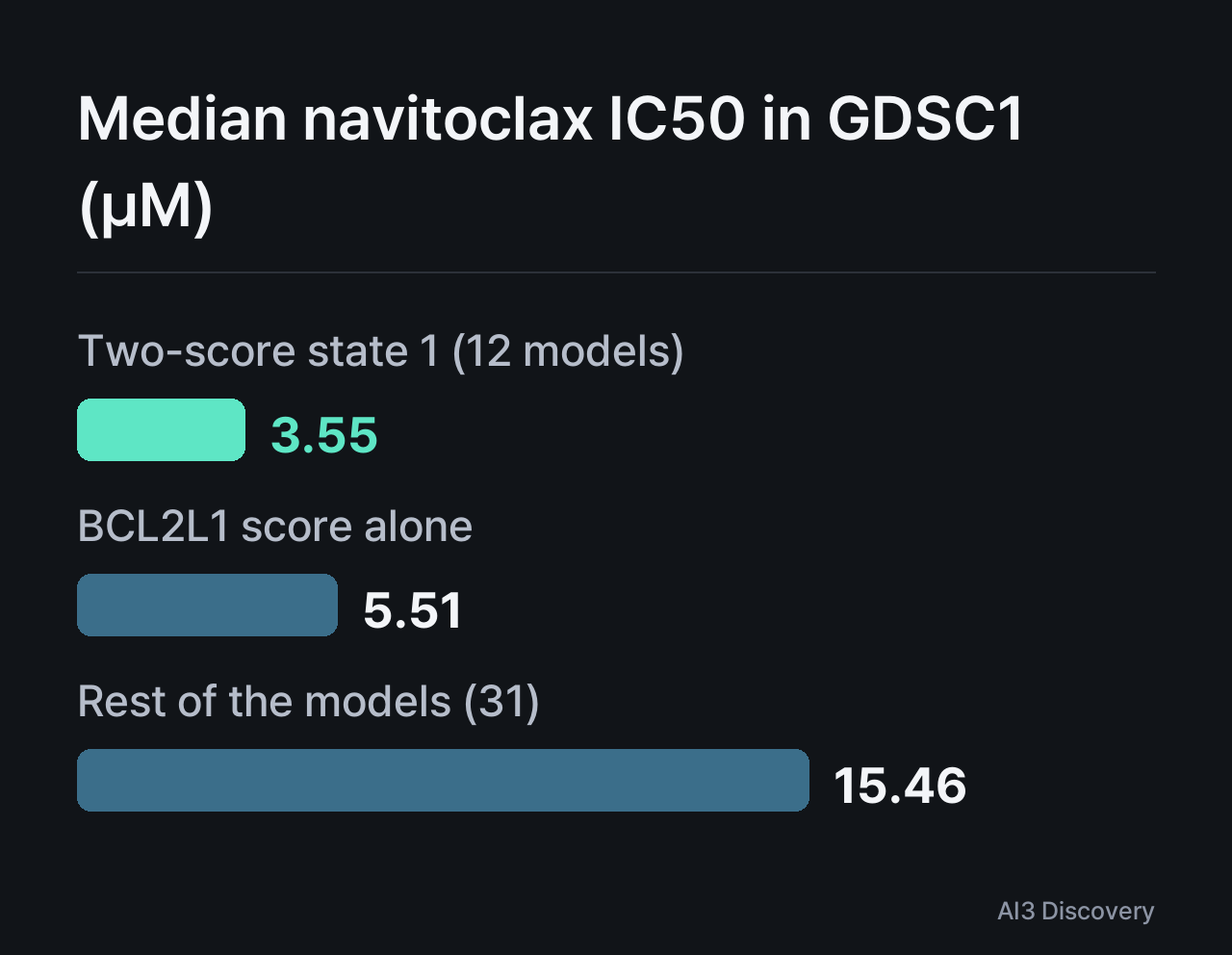
Figure 2. Median navitoclax IC50 in GDSC1 (µM). Lower IC50 means response at a lower concentration; values are calculated, and several are extrapolated beyond the tested range.
What AI3 Discovery found. Twelve CNS/Brain models meeting a two-score BCL2L1/MCL1 dependency rule had a median navitoclax IC50 of 3.55 µM, against 15.46 µM in 31 others. What is new: Earlier work links navitoclax response to BCL-XL dependence or MCL1 expression; AI3 Discovery sets a two-score dependency threshold to select glioma patients.
How it works
The mechanism, as AI3 Discovery states it, is as follows. Navitoclax blocks BCL-XL inside the cell. If a tumour cell relies on BCL-XL for survival and relies little on MCL1, there is less for it to fall back on when BCL-XL is blocked, and the cell should die. If MCL1 carries the load, blocking BCL-XL leaves a second route open.
A short analogy: a building held up by one main column and few spare supports will come down when that column is removed.
The chain the idea expects is: tumour-derived cells show a low BCL2L1 score and a high MCL1 score, so they depend on BCL-XL; navitoclax blocks it; and the cells respond at a lower concentration.
What the evidence shows - and what it does not
This is a calculation on public cell-line data from CNS/Brain models. It is not a measurement in patients or in patient-derived cultures, and the groups are small: 12 models in state 1 and 31 in the comparison.
The data sets do not agree on every readout. State 1 separates from the rest in GDSC1 IC50 (p 0.0131), GDSC1 AUC (p 0.0126, area under the dose-response curve) and PRISM MTS010 AUC (p 0.0074). It does not separate in GDSC2 IC50 (p 0.0708), GDSC2 AUC (p 0.1733) or PRISM HTS002 AUC (p 0.4637). The source summary also reports that in another data set the direction of the association is reversed. The p-values come from a rank-sum permutation test and are not corrected for multiple comparisons.
The IC50 values are partly extrapolated. Of the CNS curves, 36 of 43 in GDSC1 and 32 of 43 in GDSC2 have an IC50 above the highest concentration tested. AI3 Discovery therefore reads IC50 together with AUC.
A related hypothesis, that the difference between the MCL1 and BCL2L1 effects explains response, is still open. An exploratory correlation (Spearman ρ -0.51, GDSC1 AUC) is consistent with it and does not decide it.
Safety is a separate question that these data do not address. Thrombocytopenia (low platelet count) is a common toxicity of navitoclax; a phase 2 trial in small-cell lung cancer reported it at 41%. In the Human Protein Atlas, BCL2L1 RNA is highest in platelets among 154 normal cell types (420.3 nCPM).
What could change if it is realised
If the rule is validated, a test on tumour-derived cells could indicate, before treatment time is spent, whether an existing drug is worth trying in a patient with recurrent glioma. For clinicians it would be a criterion where there is none for this drug now. For a developer repurposing a drug, a validated rule could let a trial test navitoclax in a dependency-defined population rather than select by amplification alone.
The same criterion could support other uses. A reference panel could serve as a preclinical drug-response testing service, and the two-score procedure could be offered as a functional-genomics assay.
The road ahead
The work stands at a selection rule calculated on public data. The next test would establish whether the proposed dependency rule predicts navitoclax response under consistent experimental conditions.
Earlier studies
- Vogler et al., 2025. The BCL2 family: from apoptosis mechanisms to new advances in targeted therapy. doi:10.1038/s41392-025-02176-0
- Vera et al., 2022. Noxa and Mcl-1 expression influence the sensitivity to BH3-mimetics that target Bcl-xL in patient-derived glioma stem cells. doi:10.1038/s41598-022-20910-4
- Koessinger et al., 2022. Increased apoptotic sensitivity of glioblastoma enables therapeutic targeting by BH3-mimetics. doi:10.1038/s41418-022-01001-3
- Tagscherer et al., 2008. Apoptosis-based treatment of glioblastomas with ABT-737. doi:10.1038/onc.2008.259
The data behind this research. AI3 Discovery carried out this research on BioQ, its bio research platform. BioQ holds 97 public biological databases, each checked against its original, indexed for direct questions and cross-linked by identifier. For this study AI3 Discovery analysed GDSC (drug sensitivity of cancer cell lines), DepMap (gene dependency and expression of cancer cell lines), PRISM (a drug repurposing screen across cancer cell lines), ClinicalTrials.gov (registered clinical trials), ChEMBL (measured drug-target activity) and IMPC and MGI (mouse model phenotypes) together.
This research was carried out by AI3 Discovery on BioQ, and a patent application has been filed. Companies that wish to discuss joint development or licensing can reach us through the inquiry form; we will take them through the work in detail.
This post introduces AI3 Discovery's computational research. Nothing here is medical advice.